Wednesday, January 15, 2014

Points Inside A Production Possibility Curve (PPC)


Production possibility frontier (PPF)/ production possibility curve (PPC)

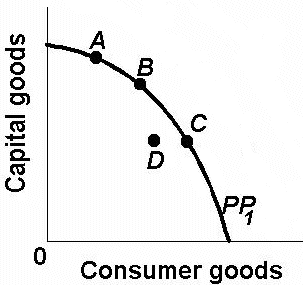
1. It is basically a curve that shows the maximum combination of two goods that can be produced in an economy if resources are fully and efficiently utilised
 

2. When we say fully and efficiently, it means that all factors of production/ resources/ inputs are assumed to be ALL used up (nothing left at the time being) to produce the highest possible number of output. Remember that these two conditions must be met so that an economy is operating along the PPC curve


3. If resources are underused/ underemployed, then the economy is said to be operating inefficiently and points are located within the curve. In such circumstance, there is no opportunity cost incurred in the production of both goods since both of them can still be increased without causing any opportunity cost to one another. In other words, when the quantity of one output is increased, it does not lead to the reduction of another (refer to the diagram above)
 

4. The concept is pretty clear if you consider yourself as a student and how you allocate your time in between a day. Suppose that you spend typically 8 hours of sleep and another 8 hours in college, from 8a.m. to 4p.m in which you are only left with maximum 8 hours for both leisure and study. Now, if you initially spend 1 hour on chilling with your friends and another 1 hour of study, you realise that you can actually increase the time spent onto both activities without getting into each other’s way, say 2 hours of both respectively


5. You can even increase both to 3 hours each without causing any opportunity cost. This is because the resource that you have, in this case the TIME, is yet to be fully used up. Once you have used up all the 8 hours for both activities, then the only way to increase one is to sacrifice the other. For example, consider a combination of 5 hours of leisure and 3 hours of study. You realise that all the balance 8 hours have been used up and the only way you want to increase your leisure activities, say to 6 hours, is by cutting down your study time to only 2 hours. Opportunity cost has occurred


6. When you look at the PPC in terms of an economy/ a country, interestingly, you will realise that no countries in the world that can actually operate on its PPC. Somehow in a way or another, there will always be resources that stay unemployed e.g. youth unemployment and machineries not put to full use. There is not much that the government can do to an entire economy. Although there are measures in place, it is somehow not possible to make sure that the coverage is universal

 
7. As such, what an economy can do is to actually push itself close to its potential limit instead of hoping to operate on its PPC instead. An economy like Singapore is perhaps already operating very close to its PPC. Most lands have been used up that they need to enlarge the existing size of land banks and if there are any other resources, it could have been all exploited

Tuesday, January 14, 2014

Cartoonomics For Chapter 1-Basic Economic Ideas (CIE AS)


Time that we have in a day is scarce. If you spend more time on leisure, then there will be lesser time available for revision. Likewise, if you spend the whole night studying for the A-Level exam,  then you are going to miss a good sleep
Which subject to take? Biology or Economics? Which college to attend? CIE or Edexcel IAL?
The North Korean dictator, Kim Jong Un challenged the USA military might last year 2013


And finally, some jokes of the day!

A Video Lesson on North Korea's Economic Failure


Monday, January 13, 2014

The List of the Most Important Definitions for Chapter 1: Basic Economic Ideas (AS-CIE)


These are some of the most important terms in Chapter 1 (AS) of our CIE Economics:
 
1. Barter: The direct trading of goods and services without the use of money

2. Capital: Man-made resources to assist in the production of goods and services such as

3. Choice: Is what someone must make when faced with two or more alternative uses of a resource (also known as economic choice)
  
4. Centrally planned economy/ command economy: An economic system which allocates scarce resources via central planning and whereby private sectors are not allowed to exist

5. Division of labour (specialisation): It is when a complicated task is broken down in many smaller units, each done repetitively by a group of workers or individuals

6. Economic goods: Goods that have an opportunity cost

7. Economic growth: It is when there is an increase in the production possibility curve/ outward shift of the production possibility curve/ potential output

8. Factors of production: They are inputs such as land, labour, capital and enterprise used in the production of goods and services 

9. Free goods: Goods that are naturally abundant and so do not incur any opportunity cost

10. Free market economy: An economic system which mainly uses the price mechanism to allocate scarce resources and whereby government intervention is assumed to be minimal to none

11. Land: Natural resources or gifts of nature that are used to produce goods and services

12. Labour: The quantity and quality of human effort directed towards producing goods and services

13. Mixed economy: An economic system which allocates scarce resources through both price mechanism and central planning, where both exist to overcome the weaknesses of one another

14. Money: Anything that is generally accepted as a medium of payment for goods and services

15. Needs: Goods and services that are essential for basic human survival

16. Normative statement: A statement that contains subjective/ value judgement and therefore cannot be proven to be true or false as both side of opinions can be equally right

17. Opportunity cost: The value of the next best alternative forgone

18. Primary sector: It is the sector of an economy which involves the extraction and production of raw materials

19. Positive statement: A statement that can be proven to be either true or false and is therefore not arguable

20. Production possibility frontier (PPF/ PPC):  A curve that shows the maximum combination of two goods that can be produced within an economy if all resources are fully and efficiently utilised

21. Secondary sector: It is the sector of an economy which processes raw materials/ natural resources into finished and semi-finished goods

22. Scarcity: It is the state of being inadequate or short in supply 

23. Tertiary sector: It is the sector of an economy which provides services to both businesses as well as consumers

24. Wants: Goods and services that are not essential but people desire them to improve their standard of living


Saturday, July 27, 2013

The United States: Market or Mixed Economy?


1. What is a market economy?
It is an economic system which allocates scarce economic resources using the price mechanism. In a layman term, there is a price tag for everything from the tuna we eat, the fuel we pump, the clothes we wear, the condominiums we stay in, the flight tickets for both our local and international holidays to the college tuition fees we pay for our children. It also covers the wages for different types of profession. Some of these prices fluctuate on a daily basis, a day up and the other day down. Some are relatively stable and often revised upward due to the willingness of consumers in paying them

In a more technical way, wages and prices that we pay for are all determined via the interactions of demand and supply. It also has other names such as the free market, capitalist and laissez-faire. Laissez-faire is actually a French term that translates as ‘let it be’ which means that an economy should be left operated on its own without any disturbances (government intervention). Through the greed for profits and own selfishness, scarce resources are said to be allocated in the ‘most efficient way’ since they go to the most deserving firms and individuals

2. How does a market economy solve basic economic problems?
The existence of scarcity in our world means any economic system must be able to address three fundamental questions and they are WHAT SHOULD BE PRODUCED? HOW IT SHOULD BE PRODUCED? and FOR WHOM SHOULD IT BE PRODUCED?

Source: economicsonline

What goods to produce and what services to provide depend heavily on the interactions of demand and supply and hence the final equilibrium price, higher or lower. Consider the housing market in Malaysia. Over the past few years, prices of properties have averagely spiked up by as much as 40% due to the buying interest of investors from overseas. A rise in demand has caused the new equilibrium price to increase and this sends a signal to all housing development firms to construct more houses and condominiums. The logic is, higher prices mean more money to be made. What about subjects offered by private learning institutions like HELP Academy and Taylor’s College? Well, they work the same. Higher demand for pre-U studies as a ticket to go to the top universities in the world has caused all colleges to be rushing in with the A-Levels programme

How those goods and services were to be produced will depend on the nature of the industry itself and the management skills of people appointed to run the firm. Some industries are labour intensive while others capital intensive. Whichever it is, the most cost efficient one will be considered at the end of the day. Similarly, is the firm willing to pay a little bit more to retain the most talented workers? If yes, the economic benefits for the firm are tremendous. Highly skilled and most experienced workers are not just scarce but also very productive, helping the firm to reduce costs in every way. On the other total revenue generated will be high due to their craftsmanship, teaching skills which will attract more students, ability to cook wonderful dishes and others

For whom those new luxury condominiums are built for? For whom those designer watches, shoes and bags are targeted at? How many units an individual or firm can get? Perhaps the best answer is none other than how much a person is willing and able to pay for it. Firms which are motivated by high profits will definitely sell the expensive houses, collectibles, antique cars and furniture and A-Level study to people who are prepared to pay a hefty price for it while at the same time gain satisfaction out of it. Remember, we as consumers always want to maximise our utility and well being and therefore if we are able and willing to we will always want the best for everything

3. What is a mixed economy?
It is an economic system where scarce economic resources are partially allocated via the price mechanism (as discussed earlier) and also through government interventions. Although private sectors are generally more productive, efficient, conduct more R&Ds or more innovative and do not waste resources, it is far from being perfect. In many circumstances, economic resources are not even allocated efficiently leading to net welfare loss. The drive to maximise profit and satisfaction has eventually led to series of economic problems. To increase annual profits and please the shareholders, thousands of jobs in a factory may need to go and where will all these unemployed people end up in? The most cost efficient method to start up farming may not even be the best. For instance, plantation firms in Indonesia chose to burn down trees rather than cutting them down resulting in deterioration of air quality, increase in respiratory illnesses, tourists shunning away from Malaysian and Singapore, decline in GDP and others

What about alcohol consumption? Consumers just want to maximise their own utility and in most cases do not consider much of the wider implications of binge drinking. The same goes for cigarettes. Do you think cigarette manufacturing companies will think of public’s health? No, they only think of ways to fatten their margin. What about education and healthcare? Some private schools and colleges are extremely expensive because consumers are willing to pay for it but what about those cannot afford? Isn’t education is universal right? The same with access to healthcare treatment. With all these arguments, clearly free market economy is highly preferred but there must also be measures to regulate the behaviour of firms and consumers

4. How does a mixed economy solve basic economic problems?

Source: economicsonline

The discussion here will focus on government interventions. What goods and services to be produced will all depend on what the government perceives to be in the best interest of the general public. For instance private universities and hospitals may be too expensive and so not everyone will be able to gain access and this is why we have government schools and hospitals all over the world. Equally national defence which is a form of public good that will never be provided under the pure market system. The main reason is the existence of free riders and hence the difficulty to maximise profits. Once again, the government feels that national defence cannot be absent and therefore undertakes to provide it. Also, it can be quite dangerous if national interest lies in the hand of greedy entrepreneurs

The government seeks to maximise welfare and hence will consider methods of production which will benefit more people. This partly explains why all governments are the largest employer and also more inefficient compared to the private. To maximise welfare within the society, jobs are purposely created to absorb those unemployed people resulting in non-necessary departments, more paper works and layers of bureaucracy. They shouldn’t even be there in the first place

To address the last question, government will always try to seek equity or fairness. Goods and services produced will always go to those that need it the most rather than on a discrimination of who can afford to pay for it. This is why there are affordable housing schemes, healthcare treatments and national schools. On top of that, there are many ways in which the government can regulate the economy. I will discuss this in another separated post

5. Is USA a market or mixed economy?
In textbooks, USA is always being regarded as a market economy but in reality it would be better if one says that the States is a better proxy of capitalism rather than being one. As a matter of fact, there is no pure capitalist or socialist in the real world. Every economy is in fact mixed and the key issue is the degree of mix from one country than the other. As for the USA, it is definitely a mixed economy but rather one with larger roles from capitalism. The credit crunch crisis and the near collapse of Ford and GM are some of the good examples which prove that pure market system cannot survive on its own. The greed for profits has caused the banks to ‘misbehave’ and finally they collapse and require the government to intervene by pumping in tax payers’ money. On top of that, there are minimum wage, carbon tax, progressive income and corporate tax, Social Security, Medicare and a lot more which are not even possible under market economy
Thursday, July 18, 2013

Haze and its Negative Externalities


1. What is the meaning of market failure?
The word ‘market’ refers to capitalist/ free market/ market economy while the word ‘failure’ means not functioning well. Putting it all together, in a way that is much easier to understand is the free market economy fails to function properly/ has too many problems. This is the layman way of understanding. I always tell my students not to be afraid with all these economics jargon. In fact most of them can be easily understood and remembered, so long as we try to understand them PART-BY-PART

The more technical definition would be the interaction of price mechanism / demand and supply fails to allocate economic resources in the most efficient way resulting in net welfare loss (more costs than benefits)

2. What are some of the examples of market failure?
Before getting there, we need to basically understand the essence of a market economy. Under such system, it is always assumed that the role of government is limited or perhaps to some degree none. Cash is king and those who are able and willing to pay will decide how the scarce economic resources will be directed to provide what they want. Consumers just want to maximise their utility (satisfaction). Meanwhile, firms are crazy over figures e.g. lowest cost and highest price possible to widen their margin of profits. The most responsive ones in a dynamic business environment will thrive while those which are slow to react will slowly perish

These have often caused some goods and services to be either under provided and hence under consumed or over provided and hence over consumed. In one or two cases, some goods/ services are not even provided despite it bring economic benefits

Consider merit goods/ goods that create positive externalities like education and healthcare. In a free market, these two will only be provided to a small group of consumers who are willing and able to pay for it, despite some argue that they are both universal rights and shouldn’t be abused to that extent. Now, I hope you can see why private colleges and hospitals are so expensive. Fees and charges are often revised upward between 5%-10% on annual basis. If there is no government intervention to fix such market failure, knowledge and health inequality between the rich and poor would have widened

Now, consider demerit goods/ goods that create negative externalities such as cigarettes, alcohol and fatty foods. In a free market, cigarette manufacturers will only consider their profits and nothing else. They will go to all extent to push young adults to indulge in smoking despite its costs far outweigh its benefits. They are not concern with consumers’ health, risks of fire in the building, litters all over the place and many more. Equally, McDonalds cares very little over issues like obesity, heart failure, diabetes and others. Profit is number one goal. This explains why the government needs to intervene with measures like awareness campaign and fatty tax

There are obviously many more problems e.g. absence of public goods, income inequality, information failure, private monopolies and others. I will talk about these in other posts

3. What about the recent haze in Singapore and Malaysia?
The haze which peaked in early July 2013 is a perfect example of negative externality/ external cost. It is defined as a negative third party effect/ spill over from production/ costs which the price mechanism fails to take into account or social costs minus private costs


We didn’t start the forest burning but since our neighbour is so insensitive, eventually we are affected by it too. The private cost (PC) to firms involved is technically zero since it costs nothing other than to start with a small fire. The external costs (EC) are tremendous especially to Singapore which is closer to the Indonesia. Health problem e.g. respiratory illnesses will escalate, tourists will temporarily shy away and spend their money elsewhere, hotels getting all the booking cancellation and street food operators are all affected because people choose to spend more time indoor. If this persist for a quarter (July-September), then I wouldn’t be surprised that the Singapore’s national income will contract this financial year

4. How can this be illustrated on a cost-benefit diagram?


Private firms will only take into account their own private benefits and private costs when they operate. This is why open burning is so rampant at Q1 where MPB = MPC. However, from the society’s point of view open-burning is a public nuisance and therefore should be reduced to a more tolerable level which is Q2 where MSB = MSC. Welfare loss is resulted as can be seen from the shaded red triangle. This is because there is an over-production of haze by the amount of Q1Q2. We assume that there are no external benefits involved and so MEB = 0. This explains why the MPB = MSB. The purpose is to make the analysis simpler. In reality, there are external benefits e.g. higher profits to the private hospitals and of course masks provider